

“And they, continuing daily with one accord in the temple, and breaking bread from house to house, did eat their meat with gladness and singleness of heart, praising God, and having favour with all the people. And the Lord added to the church daily such as should be saved.” —Acts 2:46,47. The early church's sense of urgency could not have been stronger.
The way that Jesus had answered the question concerning the establishment of the Messianic kingdom, could be understood to mean that everything depended on the coming of the Holy Spirit and the completion of the apostolic mission.
So, when Pentecost came, early believers thought that everything was fulfilled. They had received the Spirit and shared the gospel with the whole world, even though they had not left Jerusalem at this point. But in reality the whole world had come to them. — Acts 2:5-11
But was the mission of taking the gospel to the whole world completed? Obviously not! The admonition still stands; “But ye shall receive power, after that the Holy Ghost is come upon you: and ye shall be witnesses unto me both in Jerusalem, and in all Judaea, and in Samaria, and unto the uttermost part of the earth.” —Acts 1:8
 To this day, humanity has not completed the task of taking the gospel to all the world – or we wouldn't be here. But we have the counsel of Christ Himself. “Be ye also ready, for in such an hour as ye think not, the Son of man cometh.” —Matthew 24:44
We are to be prepared at any time to meet the Son of man face to face. In our daily home lives, in our daily working routines, in our dealing with other people, we are at all times to function and conduct ourselves as if Jesus was watching our every thought and action, but we often act as if there were no watching eye upon us. But the unseen eye is all observing.
“But of that day and hour knoweth no man, no, not the angels of heaven, but my Father only.” —Matthew 24:36
“The Lord has wisely concealed this from us, that we may always be in a state of expectancy and preparation for the second appearing of our Lord Jesus Christ in the clouds of heaven.” —Letter 28, 1897
Then, the very next words in that letter, continue. “We are to search the prophecies that point to the roll of fast fulfilling events, and which Christ has plainly told us will take place prior to the end of this earth's history. We are to watch and pray, wait patiently, and work faithfully to save perishing souls. Time is a most precious talent, and every moment is to be improved in doing our work wisely and well, so that if we are suddenly called to lay off the armor, we may be prepared to give up our account to God.” —ibid
We are still here, professing to be God's true church – the remnant; but are we as fervent in our day as the apostles were 2000 odd years ago? It may just be that God had a better equipped people to work with back then, than He does now, perhaps!
Today with the media, publications and ease of travel, we have so many advantages, but what about the willingness, the will to go and share our message in our homes, in our neighbourhood, in our cities and nations? It's not so much the money and means that God needs, it is willing heart’s of men and women! If our hearts were right with God and with each other, the we would see our opening verses of Acts 2:46,47 fulfilled!
What happened next was the church's detachment from material goods. Sensing that the time was short, they sold all they had and devoted themselves to learning and to fellowship while continuing to witness about the resurrection of Jesus. But at this early stage, they had only fulfilled first base of Acts 1:8 – they were still in Jerusalem.
 Teaching and Fellowship
After the miraculous experience of Pentecost, Luke focuses more on the inner experience of those involved. “And they continued stedfastly in the apostles' doctrine and fellowship, and in breaking of bread, and in prayers.” —Acts 2:42
Four main ingredients in this verse are; teaching and learning the doctrine, fellowship one with another, breaking of bread together and time in prayer. With the magnificent display of the Holy Spirit's coming and His presence, it is obvious that it left a deep impression on all the beholders. More than that, it activated them to learn more and do something with it. With this learning and willingness to be possessed by the Holy Spirit, it was not without effect. “And fear came upon every soul: and many wonders and signs were done by the apostles.” — Acts 2:43
The need to be together was another important factor. They were individuals, and they had their struggles, but from their searching, praying and confessing previously, they became of one accord. All differences were put aside, pride and independence were laid aside. While it seems hard for us to comprehend that human beings can get on so well with one another, it can be done! If men will strip away all desire for self, there can be a fervent love for Christ and for one another.
“And all that believed were together, and had all things common; And sold their possessions and goods, and parted them to all men, as every man had need. Neither was there any among them that lacked: for as many as were possessors of lands or houses sold them, and brought the prices of the things that were sold, And laid them down at the apostles' feet: and distribution was made unto every man according as he had need.” —Acts 2:44,45; 4:34,35
They were prepared to sell off all they could and trusted their brethren and pooled the money to see the work go ahead. This sharing allowed them to experience a deeper sense of unity together. They all trusted God that He would supply their daily needs, they all felt there would not be a need for a future in this world, as the end was nigh at hand and their resources went to where their passion was.
“After the descent of the Holy Spirit the disciples went forth to proclaim a risen Saviour, their one desire being the salvation of souls. They rejoiced in the sweetness of the communion with saints. They were tender, thoughtful, self-denying, willing to make any sacrifice for the truth's sake.
“In their daily association with one another they revealed the love that Christ had commanded them to reveal. By unselfish words and deeds they strove to kindle this love in other hearts... They were to go forward in willing obedience to the new commandment: "As I have loved you, that ye also love one another." – John 13:34
So closely were they to be united to Christ that they would be enabled to fulfil His requirements. The power of a Saviour who could justify them by His righteousness was to be magnified.” —Testimonies for the Church, vol.8, p.241
 The Healing of a Lame Man
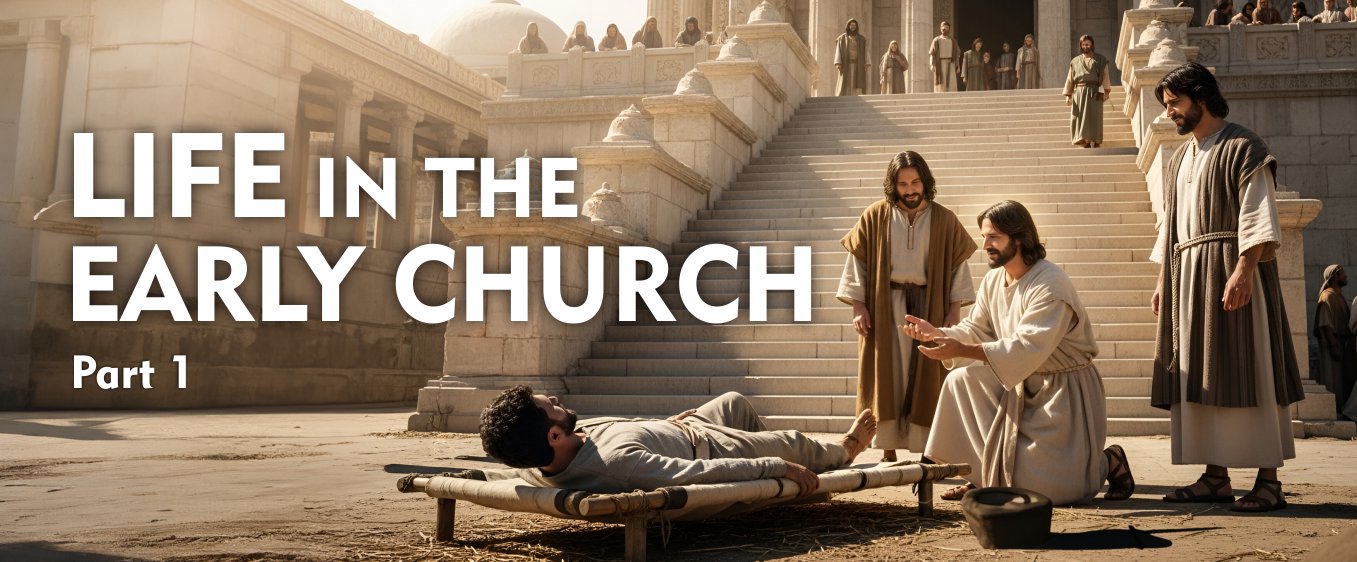
“Now Peter and John went up together into the temple at the hour of prayer, being the ninth hour. And a certain man lame from his mother's womb was carried, whom they laid daily at the gate of the temple which is called Beautiful, to ask alms of them that entered into the temple; Who seeing Peter and John about to go into the temple asked an alms. And Peter, fastening his eyes upon him with John, said, Look on us. And he gave heed unto them, expecting to receive something of them. ” —Acts 3:1-5
In the hearts of even the early disciples, the Jewish religion was still very much a part of them, as it would have been instilled in their thinking all their lives prior to this huge culture change that Jesus brought. While that may have been the case, as Peter and John were visiting the temple, they now had another reason while there – before they even got into the temple, to share the present truth of Jesus and His resurrection. The whole of Acts 3 is a record of what happened at that prayer service.
“Peter and John, going up to the temple to worship, saw a distressed and poverty-stricken cripple, forty years of age, who had known no other life than one of pain and infirmity. This unfortunate man had long desired to go to Jesus and be healed, but he was almost helpless, and was removed far from the scene of the Great Physician's labors.
Finally his earnest pleadings induced some kind persons to bear him to the gate of the temple. But upon arriving there he discovered that the Healer, upon whom his hopes were centered, had been put to a cruel death...
“As Peter and John passed, he begged charity from them... The poor man's countenance had fallen when Peter declared his own poverty, but grew bright with hope and faith as the disciple continued. "And he took him by the right hand, and lifted him up: and immediately his feet and ankle bones received strength...
“The Jews were astonished that the disciples could perform miracles similar to those of Jesus. He, they supposed, was dead, and they had expected all such wonderful manifestations to cease with Him. Yet here was this man who had been a helpless cripple for forty years, now rejoicing in the full use of his limbs, free from pain, and happy in believing on Jesus.
“The apostles saw the amazement of the people, and questioned them why they should be astonished at the miracle which they had witnessed, and regard them with awe as though it were through their own power they had done this thing. Peter assured them it was done through the merits of Jesus of Nazareth, whom they had rejected and crucified, but whom God had raised from the dead the third day...” —Story of Redemption, p.249
The following verses of Acts 3, record Peter's powerful sermon with five main points:
Jesus was the expected Messiah (verse 18)
God resurrected Him (verse 15)
Jesus was exalted in heaven (verse 13)
He will come again (verse 20)
Repentance is necessary for the forgiveness of sin (verse 19)
 Little has changed for us!
In many ways, this is the same message we are to take to the world. The 'present truth' may have changed from the time of their teaching, but we are still to present those five points that Peter presented all those years ago. They are still current for our teaching and sharing in this our day.
As the early church was established, there was a significant shift in the thinking of the Jews, including the disciples. They were to grasp the change from the 'old' covenant to the 'new'. It was a huge change! From the process of the sanctuary service, the daily sacrifice of the required offerings, the application of the blood taken into the holy place, and the most holy place, the meaning of the furniture and the application of the furniture’s meaning, all had come to its end. What that sanctuary service stood for, for so many years, had been fulfilled in Jesus Christ in person.
He was the sacrifice, His was the blood applied in the holy and most holy places. He was the antitype of the types and services. It was He, the Son of God in living flesh! The death, the resurrection, the ascension, the hope of His return was the present truth those first disciples were to take to, first Jerusalem, then Samaria and to the world.
And so for us; there is to be a significant shift in our thinking, from asleep to awake, from lukewarm to piping hot! But it may be just as difficult and huge for us to shift from 'old' Laodicean condition to grasp the 'new' condition of 'gold, white raiment, and eye salve'.
Yes, the ‘present truth’ message may have shifted from the resurrection of Christ in their day, to the coming of Christ in our day, but the core message is essentially the same. It is an everlasting gospel. Christ sacrificed His life for all humanity, in that He died for their sins in that early church, as also for us in our day. He was resurrected for them as well as for us. He will return for His children – for them and for us. All mankind can find salvation in Him, yes, for all humanity, for all time.
For the early disciples, the power in their message was that Jesus was the Messiah, the Christ garbed in humanity. He died and ignominious death, but His resurrection was hope for them in that very Person, Jesus Christ. It was the 'current news'. For us, the emphasis is more on the second coming and preparation for that great day.
The Rise of Opposition
Chapter 3 is a bright and sunny chapter, of Peter and John going to the temple for prayer meeting, but as they went to the temple, they were greeted with a poor wretch of a man who was desperate for help. After the miraculous healing, Peter’s message is recorded for all to read, of hope in Christ. His message was with power and conviction from that time up through millennia to our day.
Chapter 4 casts a shadow of darkness over chapter 3. The administrion of the temple were not pleased with what happened in chapter 3. “And as they spake unto the people, the priests, and the captain of the temple, and the Sadducees, came upon them. Being grieved that they taught the people, and preached through Jesus the resurrection from the dead. And they laid hands on them, and put them in hold unto the next day: for it was now eventide. ”— Acts 4:1-3
As the disciples rebuked the unbelief of those who witnessed the healing of the lame man, it surely began to raise the ire of the leaders of the temple. The temple at Jerusalem was run by the high priest and his associates, primarily Sadducees. The high priest was also the leader of the Sanhedrin council, which in those days was made up mostly of Sadducees and Pharisees. Because the Sadducees did not believe in the resurrection, they were greatly disturbed that Peter and John were teaching that Jesus had been raised from the dead. At all costs, they were to be silenced, so the apostles were arrested by the temple guards and put in hold until the following day, where they were brought before council to be questioned and in their thinking, to be condemned and quieted.
As the council assembled the following morning, the first question was asked; “...By what power, or by what name, have ye done this?” —Acts 4:7. Peter and John could have easily retorted back and said, “Didn't you listen yesterday? Are you so clouded in your mind that you don't know what has happened over recent weeks?” But no, this just gave another opportunity to share the 'present truth'.
 Peter’s Rebuke
“Then Peter, filled with the Holy Ghost, said unto them, Ye rulers of the people, and elders of Israel...” —Acts 4:8
It was not so much Peter that did the talking. Yes, he had proven to be very vocal, but even then, with all his talk – he was a vessel being used. Ultimately, it was the Holy Spirit that gave unction to proclaim this message. It seemed to the leaders that this was not a matter of ignorance in regards to who the disciples were talking about, it was more the concern of power – that if this new message and movement were allowed to continue, it would soon be out of their control.
But Peter bypassed that. He just declared the miracle of the healing of the cripple was performed in the name of Jesus Christ and that salvation comes directly from Him. The apostles knew the authority these men had, yet standing in their presence, they well knew they had still a higher power in their midst as well – one that the temple leaders needed to meet and know – personally.
Also these leaders didn't realise how accurate they were fulfilling prophecy by their actions towards the disciples. “Behold, I send you forth as sheep in the midst of wolves: be ye therefore wise as serpents, and harmless as doves. But beware of men: for they will deliver you up to the councils, and they will scourge you in their synagogues; And ye shall be brought before governors and kings for my sake, for a testimony against them and the Gentiles. But when they deliver you up, take no thought how or what ye shall speak: for it shall be given you in that same hour what ye shall speak. For it is not ye that speak, but the Spirit of your Father which speaketh in you.” —Matthew 10:16-20
To add insult to injury for the Sanhedrin, the man who had just been healed was present, the miracle could not be denied. It became so intense that the leaders demanded the disciples to stop preaching. They feared the message as much as the force of the message and popularity of the movement now under way.
Rather than thinking it through for long term results, they could only think of the immediate effect, and that was that they felt they were losing control over the people and they would fight tooth and nail to save their authority and power. Their response was self-preservation.
But Peter and John were not disturbed about it all and used some very clear and impacting words at the closure of his discourse. “Whether it be right in the sight of God to hearken unto you more than unto God, judge ye. For we cannot but speak the things which we have seen and heard.” —Acts 4:19,20
This conclusion is very similar to the words spoken by Gamaliel in “Refrain from these men, and let them alone: for if this counsel or this work be of men, it will come to nought: But if it be of God, ye cannot overthrow it; lest haply ye be found even to fight against God.” —Acts 5:38
But it doesn’t end there either. While the devil did all he could to derail that fledgling Christian church, there were those dedicated ones who stood for the right, even though the heavens may fall. That determination is recorded on those sacred pages of history, that it may give us hope for our day. If they could stand for the right, then so can we.


