


Dear Friends
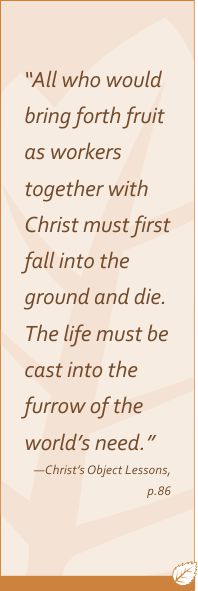
“And he spake many things unto them in parables, saying, Behold, a sower went forth to sow; And when he sowed, some seeds fell by the way side, and the fowls came and devoured them up: Some fell upon stony places, where they had not much earth: and forthwith they sprung up, because they had no deepness of earth: And when the sun was up, they were scorched; and because they had no root, they withered away. And some fell among thorns; and the thorns sprung up, and choked them: But other fell into good ground, and brought forth fruit, some an hundredfold, some sixty-fold, some thirty-fold.” —Matthew 13:3-9
Here is a very familiar parable Jesus told to the multitude by the sea. It was a parable that most everyone there could relate to, as they were great agricultural people. Sowing grain was well understood. But the story Jesus told that day had a greater meaning. In fact, it was so significant that the people get the message, that in the very next verse, He said, “Who hath ears to hear, let him hear.” —Matthew 13:9
Then He went on to interpret the parable He had just told everyone, so that there would be no doubt. “Hear ye therefore the parable of the sower. When any one heareth the word of the kingdom, and understandeth it not, then cometh the wicked one, and catcheth away that which was sown in his heart. This is he which received seed by the way side. But he that received the seed into stony places, the same is he that heareth the word, and anon with joy receiveth it; Yet hath he not root in himself, but dureth for a while: for when tribulation or persecution ariseth because of the word, by and by he is offended. He also that received seed among the thorns is he that heareth the word; and the care of this world, and the deceitfulness of riches, choke the word, and he becometh unfruitful. But he that received seed into the good ground is he that heareth the word, and understandeth it; which also beareth fruit, and bringeth forth, some an hundredfold, some sixty, some thirty.” —Matthew 13:18-23
Here is a very clear example of the seed being sown, but while the seed is willingly broadcast, the ground it landed on had varied reactions and response. Let's get it clear though, there was nothing wrong with the seed. It was the same quality of seed that fell all over the ground.
 From here Jesus merged the agricultural lesson into the spiritual. There were degrees of reception. Some ground was hard, just as some hearts were hard and the enemy stole that blessing away from the hearer.
Some seed fell on stony ground. It took root in the heart of the hearer, but was soon uprooted shortly after. Some seed fell on thorny ground. It took root in the heart of the hearer, but was soon choked out with the weeds of temptation and distraction. But it was the seed that fell into the good ground, was nurtured and grew well that produced a harvest.
All the seed sown died to itself, but it was only the seed that fell into good ground that multiplied and brought a harvest. The other seed died to itself producing nothing, but not the fault of the seed. It was the fault of the hearts receiving the seed.
Eve
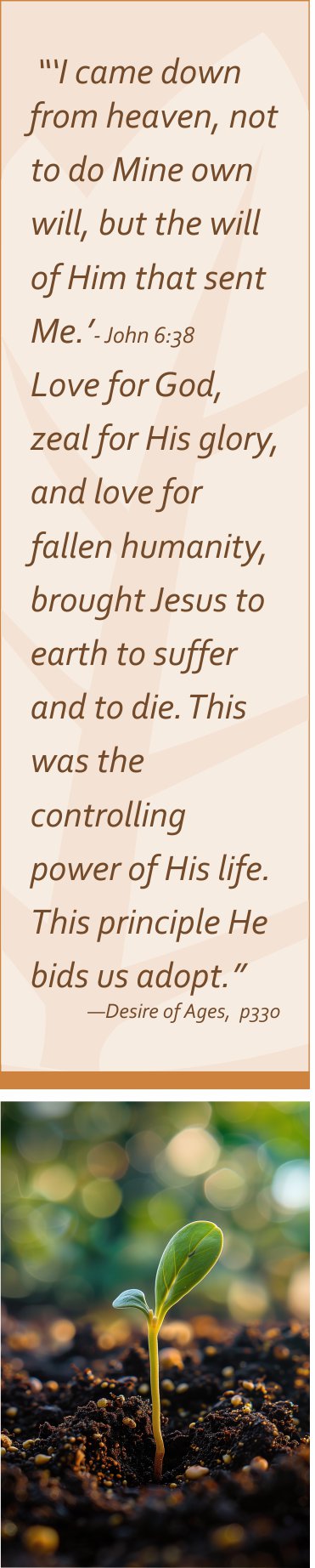
What are some examples in the Bible that we can draw lessons from? A very unique case was that of Eve. She was directly from the creative hand of God. She, with Adam, were given freedom of choice. She had a divine nature, no contamination with sin at all and daily she, with Adam, had been counselled to keep away from one tree in particular, as it would give a knowledge of good and evil. At that point, both of them only knew good. But she had freedom of choice and in her own wisdom, she put God's wisdom on the shelf, so to speak, and used her own wisdom to decide for herself what was good and right. She trusted her own judgment.
As she approached the tree without Adam by her side, she was introduced to the talking serpent in that very tree, and with the words spoken by that serpent, which were really the words of Satan using the serpent, she began to doubt the spoken word of God.
Going against the warning of angels, she became infatuated with the unknown and fell all too easily because of her doubt. So the question is, was she seduced into her fall, or was it self-dependence? Did she die to self, or fraternise with fantasy? Of the examples given in the parable of the sower, she doesn't really fit, but none-the-less, she chose the distractions and temptations that fit the parable exactly. The seed of God, or the Spirit of God had not taken deep root in her heart and she betrayed her sacred trust and let God down badly.
Saul
What about Saul in his downfall that destroyed his future of being king? He would be also of any one of the first three examples of the parable of the sower.
War was declared between Israel and the Philistines. Samuel was very clear in telling Saul, wait until I come to offer sacrifice. Saul had other ideas. “And he tarried seven days, according to the set time that Samuel had appointed: but Samuel came not to Gilgal; and the people were scattered from him. And Saul said, Bring hither a burnt offering to me, and peace offerings. And he offered the burnt offering. And it came to pass, that as soon as he had made an end of offering the burnt offering, behold, Samuel came; and Saul went out to meet him, that he might salute him. And Samuel said, What hast thou done?...” —I Samuel 13:8-13
Would this be a clear case of self-dependence? Well to add to that we have Saul's life a bit later. “Then said Saul unto his servants, Seek me a woman that hath a familiar spirit, that I may go to her, and inquire of her. And his servants said to him, Behold, there is a woman that hath a familiar spirit at Endor. And Saul disguised himself, and put on other raiment, and he went, and two men with him, and they came to the woman by night: and he said, I pray thee, divine unto me by the familiar spirit, and bring me him up, whom I shall name unto thee.” —I Samuel 28:7,8
Saul's life was choked with weeds and bramble, the roots were pulled out and that seed shrivelled up. His life was a complete misery – troubled by the devil to his dying day.
 Peter
Peter
But here is another case! “Peter answered and said unto him, Though all men shall be offended because of thee, yet will I never be offended. Jesus said unto him, Verily I say unto thee, That this night, before the cock crow, thou shalt deny me thrice. Peter said unto him, Though I should die with thee, yet will I not deny thee.” —Matthew 26:33-35
From Matthew 26:69 onwards, is the experience of where Peter starts to deny even knowing who Jesus was. In verse 75, we see that complete self-reliance, a total dependence on his own abilities to a dramatic change to something else. When that cock crowed that morning: “… Peter remembered the word of Jesus, which said unto him, Before the cock crow, thou shalt deny me thrice. And he went out, and wept bitterly.”
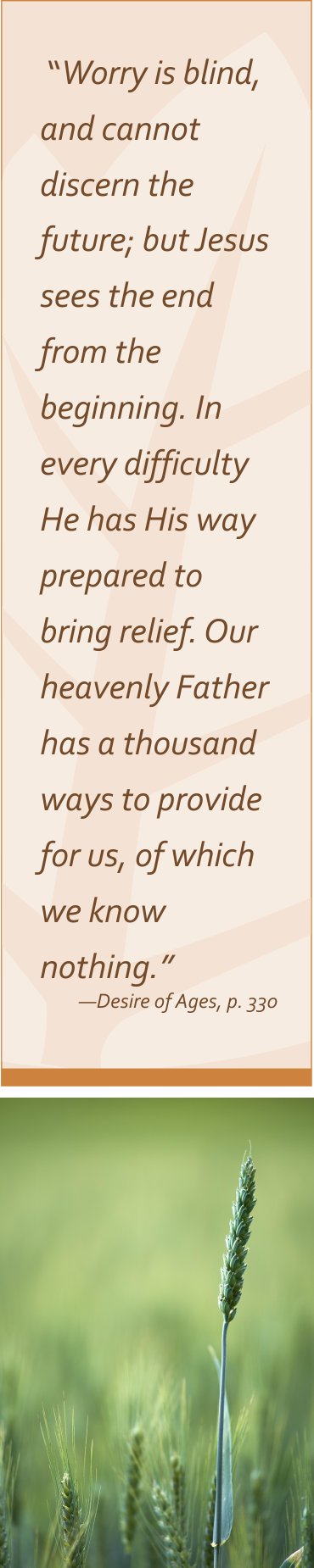 “It was after Peter had been led to self-renunciation and entire reliance upon divine power, that he received his call to act as an under-shepherd. Christ had said to Peter, before his denial of Him, 'When thou art converted, strengthen thy brethren.'” —Luke 22:32.
These words were significant for the change in Peter's experience from being self-reliant, to self-denial. His life before his conversion was well explained by the first examples of Jesus in the parable, but after his conversion certainly was the seed dying to self and producing a harvest of souls.
He would go on to the wide and effectual work which he was to do for those who should come to the faith. For this work, Peter's own experience of sin and suffering and repentance had prepared him. Not until he had learned his weakness, could he know the believer's need of dependence on Christ. Amid the storm of temptation he had come to understand that man can walk safely only as in utter self-distrust and total reliance upon the Saviour.
At the last meeting of Christ with His disciples by the sea, Peter was tested by the thrice-repeated questions, ‘Lovest thou Me?’ —John 21:15-17 He was restored back to his place among the disciples, but now a very different person. His work was now appointed him; he was to feed the Lord's flock. Now, converted and accepted, he was not only to seek to save those without the fold, but was to be a shepherd of the sheep.” —Acts of the Apostles, p.515
This is a case where the seed eventually fell in good ground and produced a harvest, and is still producing a harvest, but oh, what a lot of cultivating had to be done by Jesus to get him to that point in his life.
Deep Roots
If we are confronted with trial and trauma, we must put our roots down deep to hold on through the ordeal. Many come to difficult situations and fall apart. Even those who claim to carry the name of Christian, and we turn to fancies of this world to prop us up, like extravagant hobbies, sports, even unfaithfulness in marriage if the marriage is having difficulties, but all too often those solutions bring relatively short-term rewards and satisfaction. It is only in Jesus that we can endure trying circumstances with long term peace and satisfaction.
It is certainly not uncommon to find ourselves in difficult circumstances, even to the point of suffering, but to work through those struggles and not to just give up to the world around us and hold on to the promises of God, will bring that long term peace-of-mind and a vision of a better world. It will be worth it – every time. When under severe pressure, remember this, it will pass! Job endured everything thrown at him – and all through it he said; “Though he slay me, yet will I trust in him…”— Job 13:15
Is it possible to move from stony, dry, shallow, choked ground to rich, deep and productive soil?
David
David got himself into some awful predicaments, even stealing another man's wife and organising his death, but out of it all, he deeply repented and God was merciful and held him up and carried him through.
“I will lift up mine eyes unto the hills, from whence cometh my help.
My help cometh from the LORD, which made heaven and earth.
He will not suffer thy foot to be moved: he that keepeth thee will not slumber.
Behold, he that keepeth Israel shall neither slumber nor sleep.
The LORD is thy keeper: the LORD is thy shade upon thy right hand.
The sun shall not smite thee by day, nor the moon by night.
The LORD shall preserve thee from all evil: he shall preserve thy soul.
The LORD shall preserve thy going out and thy coming in from this time forth, and even for evermore.” —Psalm 121
This is a beautiful Psalm of reassurance that our God will not leave us floundering on our own, but He will watch over us, caring for us and bringing victory within our reach.
Submission and Reassurance
James is a very practical book, covering what many of us well understand, because we have gone through the experiences he writes on. “But he giveth more grace. Wherefore he saith, God resisteth the proud, but giveth grace unto the humble. Submit yourselves therefore to God. Resist the devil, and he will flee from you. Draw nigh to God, and he will draw nigh to you. Cleanse your hands, ye sinners; and purify your hearts, ye double minded. Be afflicted, and mourn, and weep: let your laughter be turned to mourning, and your joy to heaviness. Humble yourselves in the sight of the Lord, and he shall lift you up.”— James 4:6-10
Submission to God comes as we die to our own selfish desires and ambitions. As this submission takes priority in our hearts and minds, a willingness to serve others becomes tasteful. We cannot live for God without a desire to sacrifice the interests of this life, to live His life.
For us to truly submit our wills to our Father's will, we must cast away the self-interests and self-reliance.
Then when we do die to self, it will empower us to go through the tough times – the crucible experiences – and with Job, we may say, “Though he slay me, yet will I trust in him…”
Yes, there are many examples of souls moving from unproductive soil to the rich, well-watered and cultivated soil and eventually producing a harvest. The seed of selfishness was planted in the soil and due to
the miracles of God, produced many, many more seeds, a real harvest.
The real problem God has, is that it is the individual heart that has to do the moving from dry, stony, choked soil to the rich. God won't force us, it is our choice. How many of us are willing to put our hand up and ask God to shift us out of our comfortable lifestyle to work for souls.
“Then saith he unto his disciples, The harvest truly is plenteous, but the labourers are few.” Jesus doesn't leave it there. In the very next verse, He counsels, “Pray ye therefore the Lord of the harvest, that he will send forth labourers into his harvest.” —Matthew 9:37,38
Put your roots down in good soil, plant yourself deep and draw nutrients from the source of all life. Deny yourselves, let self die and produce a rich harvest, “while it is day: (because very soon) the night cometh, when no man can work.” —John 9:4
“When we see Jesus, a Man of Sorrows and acquainted with grief, working to save the lost, slighted, scorned, driven from city to city till His mission was accomplished; when we behold Him in Gethsemane, sweating great drops of blood, and on the cross dying in agony—when we see this, self will no longer clamor to be recognized.
We shall rejoice to bear the cross after Jesus, to endure trial, shame, or persecution for His sake.” —From Heaven with Love, p.297,298 / Condensed Desire of Ages
 Watch
Watch
“There is need of constant watchfulness and of earnest, loving devotion, but these will come naturally when the soul is kept by the power of God through faith. We can do nothing, absolutely nothing, to commend ourselves to divine favor. We must not trust at all to ourselves or to our good works; but when as erring, sinful beings we come to Christ, we may find rest in His love.
“God will accept every one that comes to Him trusting wholly in the merits of a crucified Saviour. Love springs up in the heart. There may be no ecstasy of feeling, but there is an abiding, peaceful trust. Every burden is light; for the yoke which Christ imposes is easy. Duty becomes a delight, and sacrifice a pleasure.
The path that before seemed shrouded in darkness becomes bright with beams from the Sun of Righteousness. This is walking in the light as Christ is in the light.” —Counsels for the Church, p.49
In Conclusion
In closing, with all the counsel and teaching in regards to heaven and earth, will everyone accept that counsel and change? No, they will not. But that doesn't mean God will give up on us. He will still be there for us, but when they turn our backs on Him completely, He has to turn away.
So on that note, it would do very well that we decide to plant ourselves in fertile soil, so as we do die to self, their is a harvest of souls.
“Of the seed that fell into good ground the Saviour said, This ‘is he that heareth the word, and understandeth it; which also beareth fruit, and bringeth forth, some an hundredfold, some sixty, some thirty...That on the good ground are they, which, in an honest and good heart, having heard the word, keep it, and bring forth fruit with patience’...
“He has an honest heart who yields to the conviction of the Holy Spirit. He confesses his guilt, and feels his need of the mercy and love of God. He has a sincere desire to know the truth, that he may obey it. The good heart is a believing heart, one that has faith in the word of God...
“The good-ground hearer receives the word ‘not as the word of men, but as it is in truth, the word of God.’ —1 Thessalonians 2:13. Only he who receives the Scriptures as the voice of God speaking to himself is a true learner. He trembles at the word; for to him it is a living reality. He opens his understanding and his heart to receive it. Such hearers were Cornelius and his friends, who said to the apostle Peter, ‘Now therefore are we all here present before God, to hear all things that are commanded thee of God.’ —Acts 10:33.
“A knowledge of the truth depends not so much upon strength of intellect as upon pureness of purpose, the simplicity of an earnest, dependent faith. To those who in humility of heart seek for divine guidance, angels of God draw near. The Holy Spirit is given to open to them the rich treasures of the truth. The good-ground hearers, having heard the word, keep it. Satan with all his agencies of evil is not able to catch it away.” — Christ’s Object Lessons, p.58,59
The whole purpose of our lives, as we come to know our Saviour, is to die to self and fall into the hands of the good ground and the Holy Spirit will bring in a rich harvest. His word will not return void.

.
Related Posts


Click here for the pdf version of the Leaflet.